
Sub-Total: $0.00
Literati Bonsai
Literati Bonsai (Bunjin): An Artistic Approach
The literati, or bunjin, is less a fixed “style” of bonsai and more of an approach to design. It emphasizes elegance, minimalism, and expressive trunk movement over strict rules of balance and form, which makes the literati bonsai unique.
Difficult to pin down in words, literati bonsai often appear simple and refined, yet full of character. The term itself comes from the Japanese bunjin, which translates the Chinese word wenjin a reference to scholars and artists whose calligraphic paintings of slender, windswept trees inspired this approach.
Origins and Inspiration
- Harry Tomlinson, British bonsai artist, describes literati as trees that often resemble those growing at the seashore or in open landscapes where competition has forced them to reach dramatically for light. The trunks typically twist and flow with curves, sometimes shaped by extreme age and weather.
- John Naka, American bonsai master, noted that literati bonsai seem to “violate all the principles of bonsai form,” yet still convey elegance and freedom, which embodies the spirit of literati bonsai.
Key Characteristics
While literati bonsai resist rigid definition, they often share these qualities:
- Tall and slender form
- Minimal branching, often confined to the upper third of the tree
- Flowing or angular trunk movement, sometimes exaggerated
- Elegance in simplicity, prioritizing line over mass or taper
- Asymmetry that still feels balanced
In bonsai terms: there is “symmetry in asymmetry” and “balance in unbalance.”
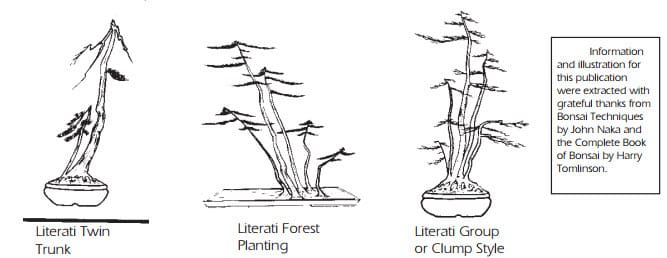
Literati as an Approach, Not a Style
A literati tree can appear as a formal upright, informal upright, cascade, semi-cascade, twin trunk, or even forest planting. What makes it literati is not the structural style but the artistic interpretation. A willingness to bend or break traditional rules while still achieving harmony, which is intrinsic to the concept of Literati Bonsai.
At its best, literati bonsai is about pushing boundaries. It asks the artist to exaggerate unusual features and find beauty in what might otherwise be considered flaws.
If it feels right, do it, just be prepared to defend your design on solid artistic grounds.
Suitable Materials
Because literati design emphasizes trunk movement and line, certain species lend themselves well:
- Junipers – elastic and ideal for twisting movement
- Pines – mature naturally into literati-like forms
- Other evergreens – strong and flexible enough for shaping
- Deciduous trees – possible, but more challenging, since branches break more easily and foliage tends to grow upright
Tip: Look for material with unusual or striking trunk movement. The uniqueness of the line is more important than heavy taper or branching, making them ideal for Literati Bonsai design.
Containers
The container should support, not compete with, the tree.
- Shallow round or oval pots are most common.
- Trays or slabs can also be used, especially with stone plantings.
- Trees are typically planted off-center for a sense of asymmetry.
- Avoid ornate or heavy-glazed containers, simplicity complements the literati’s elegance.
Care and Maintenance
Literati bonsai follow the same basic care as other bonsai, with a few special considerations:
- Stability – Their tall, slender forms can be top-heavy, so secure them against wind.
- Foliage control – Keep growth light and sparse to preserve elegance. Heavy top growth can overwhelm the delicate trunk line.
The Spirit of Literati
Ultimately, literati bonsai is about artistic freedom within naturalism. When working with Literati Bonsai, it invites experimentation, rewards bold choices, and celebrates the unusual. Done well, it expresses the resilience of trees shaped by age, hardship, and environment—simple, elegant, and deeply moving.
Next Up: Learn about Cascade and Semi Cascade Bonsai