
Sub-Total: $0.00
Forest Bonsai (Yose-ue): Designing a Living Woodland
Any bonsai planting that includes more than one trunk can technically be called a group planting. While twin and triple-trunk designs are usually treated as distinct forms, the ideas behind them are simply smaller expressions of the same principles used in a forest bonsai. For this reason, students are encouraged to become comfortable with multi-trunk arrangements before moving on to larger forest compositions.
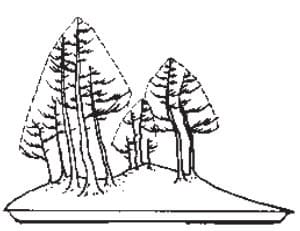
A forest bonsai shifts the viewer’s focus away from any single tree and toward the collective presence of the group. The goal is not to showcase individual perfection, but to create the feeling of a natural woodland that was shaped by time, competition, and environment.
This approach differs from Saikei, which often combines trees with grasses, groundcovers, and prominent rock features. In forest bonsai, trees remain the dominant element, and all other components exist only to support the illusion of a living forest.
Choosing Trees and Establishing Unity
Successful forest plantings begin with thoughtful material selection. Most forests are created using a single species, which helps maintain visual cohesion and simplifies care. When different species are combined, they must share similar needs for light, water, and seasonal treatment.
Trees chosen for a forest do not need flawless bonsai proportions. In fact, slight irregularities often enhance realism. In a group setting, trunks that might feel awkward on their own can contribute character and depth when placed in relationship to others. The strength of a forest lies in how the trees interact and not in how they perform individually.
Containers: Creating the Landscape Stage
Forest bonsai are typically planted in wide, shallow containers that emphasize horizontal space. These containers act as a landscape stage rather than a decorative frame, allowing the artist to suggest terrain, distance, and movement.
Unglazed trays in neutral earth tones are commonly used, as they remain visually quiet and allow the planting to take precedence. Since no single tree is meant to dominate attention, ornate or dramatic containers are usually avoided.
Size Variation and Tree Hierarchy
A convincing forest relies on variation in height and trunk thickness. Most plantings include:
- One or two dominant trees that establish scale and authority
- Several medium-sized supporting trees
- Smaller background trees that enhance depth and perspective
This hierarchy mirrors real forests, where older trees tower above younger growth. Establishing a clear visual order helps the planting feel natural and prevents the composition from becoming flat or confusing.
How Many Trees to Use
Forest bonsai often contain an odd number of trees, commonly between three and nine. Odd numbers naturally avoid symmetry, which supports a more organic appearance. That said, even-numbered forests are not forbidden and what matters most is maintaining imbalance that still feels stable.
As the number of trees increases, so does the challenge of keeping the design readable. Larger forests require careful spacing and strong visual planning to avoid clutter.
Planning and Preparation
Forest plantings require patience and preparation. Because roots are exposed and repositioned repeatedly during layout, they must be kept moist at all times. Root balls should be wrapped in damp material or temporarily soaked while arrangements are tested.
Due to the extensive root work involved, forest bonsai should be created only in early spring, just as buds begin to swell. At this stage, trees are entering their most resilient growth phase and recover more easily from disturbance.
Structure, Flow, and Visual Movement
Forest bonsai are often organized into small groupings within the larger planting. These internal clusters typically form triangular relationships that echo the same design logic used in single-tree bonsai.
Trees are usually positioned toward the back and sides of the container, leaving a more open foreground. This creates the suggestion of a clearing and encourages the viewer’s eye to move through the scene. Soil levels are rarely flat; subtle rises and dips add realism and reinforce the sense of terrain.
Larger trees are placed closer to the front, while smaller trees recede into the background, strengthening the illusion of distance despite the shallow container.
Branch Placement and Canopy Design
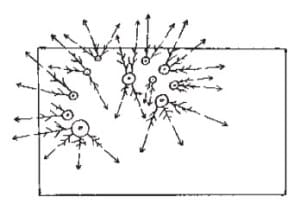
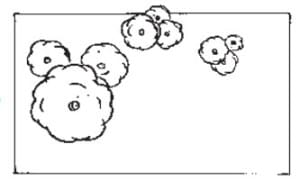
Branches in forest bonsai generally extend outward rather than inward. Inward-growing branches disrupt visual flow, block light, and weaken interior growth over time. Clear sightlines between trunks are essential to preserving depth and readability.
Canopy development follows the same principles used in single-tree bonsai: balance, direction, and negative space. However, pruning decisions must always consider how one tree affects the others, ensuring that no single canopy overwhelms the group.
Aftercare and Long-Term Development
After planting, forest bonsai should be treated as freshly repotted trees. Provide protection from direct sun and wind for the first one to two weeks, maintain high humidity, and gradually reintroduce full exposure.
As the forest matures, ongoing care focuses on preserving hierarchy. Dominant trees must remain visually dominant, while secondary trees are managed to support and not compete with the main structure. Forests evolve over time, and periodic adjustments are part of their natural refinement.
Artistic Intent and Expression
Forest bonsai are not simply collections of trees, they are expressions of environment and time. A planting may suggest a quiet grove, a windswept hillside, or an aging woodland shaped by competition and survival.
While forests often follow established design principles, they do not need to be rigid or uniform. Slanting forests, sparse groupings, or compositions centered around a single massive tree can be just as compelling when asymmetry and balance are respected.
Final Thoughts
A well-designed forest bonsai invites the viewer into a miniature world. Through thoughtful material selection, careful spacing, and attention to visual hierarchy, the artist creates not just a planting, but a place.
Forest bonsai remind us that beauty in nature is rarely solitary and it is found in relationship, rhythm, and the quiet strength of many trees growing together.
llustrations for this publication were extracted with grateful thanks from Bonsai Techniques by John Naka and Bonsai, Its Art, Science, History and Philosophy by Deborah R. Koreshoff.
Check out this article: